
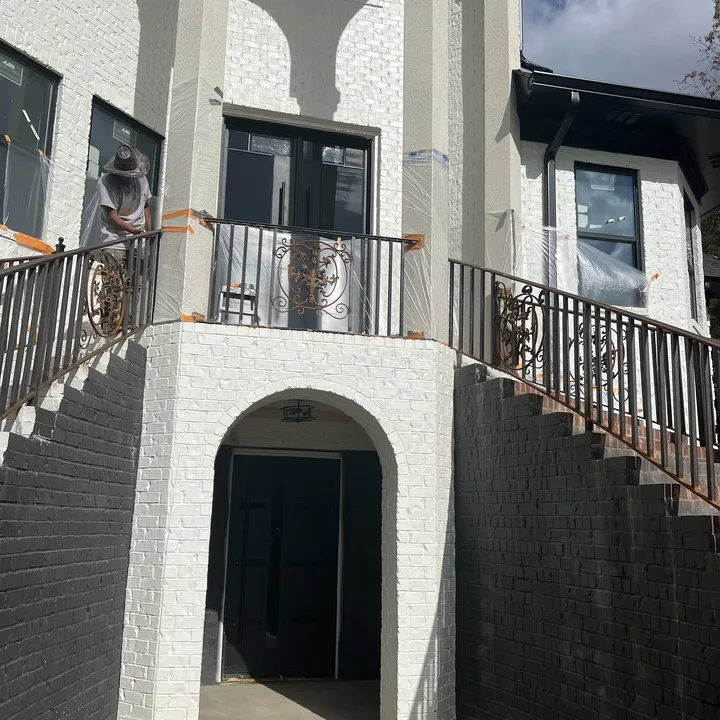
Columbia has a lot of brick, and painted brick has never been more popular. It also cannot really be undone, so it is worth understanding before you commit.
Why people do it
A mid-century brick ranch in Forest Acres or a brick two-story in Blythewood can look like a completely different house in white or a soft gray with dark trim. It is the single biggest visual change available on an exterior, and it costs a fraction of re-cladding.
It also solves a real problem: brick in a color you cannot live with, or brick that has been patched with a batch that never matched.
Why it is a serious decision
Stripping paint off brick is difficult, expensive, and often damages the face of the brick. Practically speaking, once brick is painted it stays painted, and it joins the maintenance cycle. Unpainted brick needs nothing for decades. Painted brick needs repainting like any other surface.
What makes a good candidate
- Brick that is sound, with mortar in good condition.
- No ongoing moisture problem, no efflorescence, no spalling faces.
- A surface that can be cleaned and dried properly before coating.
- Brick that is at least a year old, so it has finished curing.
If any of those are off, painting traps moisture in the wall and the coating fails in sheets. We would rather tell you that at the estimate than take the job.
How do you paint brick, step by step
The order matters more than the brand on the bucket. Skipping any of these is how a brick job starts peeling inside two summers.
- Wash it. Brick holds dirt, chalk, and mildew deep in the texture. In the Midlands there is almost always mildew on a north or shaded wall, and it has to be killed rather than just rinsed, or it grows back through the coating.
- Repair the mortar. Any cracked or missing mortar gets tuckpointed and left to cure. Paint bridges a hairline crack for about a season and then splits along it.
- Let it dry all the way. Not surface dry. Masonry holds water for days after a wash, and coating over trapped moisture is the single most common cause of failure.
- Prime with a masonry primer. Bare brick is porous and alkaline. A masonry primer handles both. On a previously painted wall the primer choice depends on what is already there and how well it is holding.
- Two coats of a breathable masonry coating, back-rolled so the texture and the mortar joints actually fill rather than bridging over.
What paint to use on brick
Use a coating made for masonry: an acrylic masonry paint, an elastomeric, or for the look a lot of people are actually after, a mineral or limewash finish that soaks in rather than sitting on top. What matters is that the coating is breathable, because brick moves moisture and the coating has to let it out.
Standard exterior wall paint is the wrong tool. It is not built for an alkaline, porous, moving surface, and on brick it is a short-term answer that looks fine the first year. Elastomeric deserves a caution of its own: it is thick and it is good at bridging hairline cracks, but on a wall with any moisture behind it, that same film traps water and blisters.
Does painting brick ruin it?
Painting sound, dry brick does not damage it. What damages brick is painting brick that was not ready: wet masonry, failing mortar, an ongoing drainage problem, or a non-breathable coating that traps moisture and pushes the face off the brick in winter. That is spalling, and it is permanent.
The fair way to put it is that painting brick is not destructive, it is committing. You are trading a surface that needs nothing for a surface that needs repainting.
Paint or stain?
Masonry stain soaks into the brick instead of forming a film over it. It keeps the texture and the variation, it is far more breathable, and it does not peel, because there is no film to peel. It also cannot go dramatically lighter the way paint can, and coverage on a mixed or patched wall is less predictable.
Rough guide: if you want a solid, uniform, painted-white look, that is paint. If you want to shift the tone of the brick while it still reads as brick, look at stain or limewash first. On a house with any moisture history, stain is the safer of the two.
Color, and the part people underestimate
Whites and warm off-whites are still the most requested, usually with dark trim, black or bronze windows, and a wood or painted door. Soft grays and greiges read well on the mid-century brick around Forest Acres. Deep charcoal and near-black look excellent on smaller elevations and get very hot on a full west-facing wall in a Columbia July.
Sample on the actual wall, not on a card, and look at it wet and dry and at three different times of day. Brick pulls color in a way drywall does not, and the mortar color shifts the result as much as the brick does.
The trim work usually matters as much as the brick itself. On most brick homes, fascia, soffits, casings, shutters, and porch structures are what set the whole look.
Interior brick
Same rules, lower stakes. An interior fireplace surround or accent wall is not fighting weather, so breathability matters less and the decision is mostly aesthetic. It is still close to permanent, and a fireplace surround needs a coating rated for the heat it will actually see.
Not sure?
Ask at the estimate. We will look at your brick, the mortar, and the drainage around the house and give you a straight answer, including when the answer is that we would leave it alone and put the budget into the trim instead.
Talk it through on a free estimate
Jason walks the job, measures, and leaves you a written price. No charge and no pressure. Call or text +1 803-746-8992, or read more about Exterior Painting.