
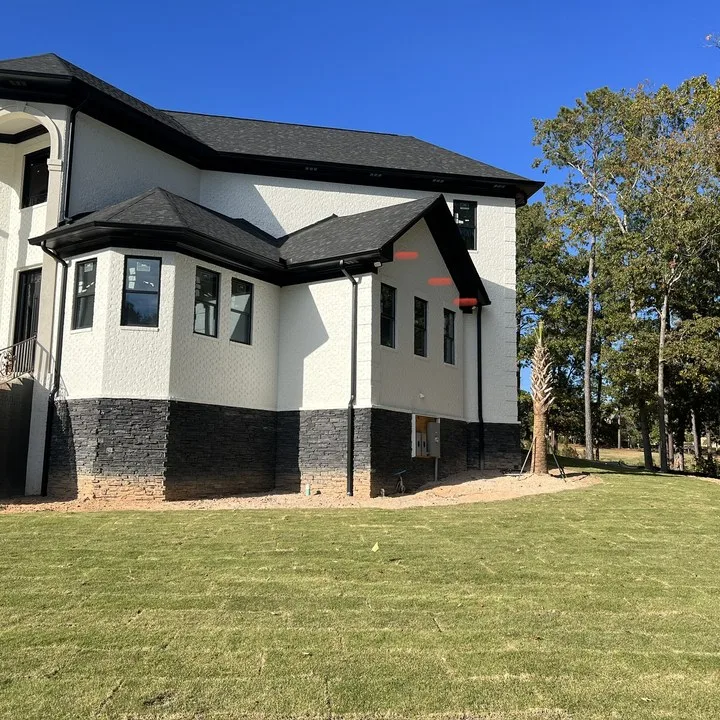
It is the first question everyone asks and the one no honest painter answers over the phone. Here is what actually moves the number, and why two estimates for the same house can be thousands of dollars apart.
Nobody likes the answer "it depends," so let us be specific about what it depends on. A painting price is built from four things: how much surface there is, what condition that surface is in, how hard it is to reach, and how many colors and finishes are involved. Change any one of them and the number moves.
Surface area, not square footage
People quote the square footage of the house, but that is floor area. What gets painted is wall area, ceiling area, and trim. A 2,000 square foot ranch with eight foot ceilings and simple trim has far less paintable surface than a 2,000 square foot two-story with a vaulted great room, crown molding in every room, and a coffered dining ceiling.
This is why an over-the-phone number is a guess. We measure the actual surfaces.
Condition, which is where the money really goes
On an interior, condition means how much patching the walls need. Nail pops, hairline cracks, old anchor holes, and previous repairs that were never sanded flat all get fixed before color goes on. On an exterior it means scraping failing paint, priming bare wood, and re-caulking joints that have opened up.
In older Columbia neighborhoods like Shandon and Rosewood, prep is most of the labor on an exterior. In a newer Lexington or Blythewood subdivision, the substrate is usually sound and the job is a wash, spot caulking, and quality coats. Same size house, very different price, and the difference is entirely in the prep.
Access
A two-story elevation with a tall front gable is not harder to paint than a ranch, but it is harder to reach safely. That means ladder work, sometimes lift work, and more days on site. The same is true inside for two-story foyers and open stairwells.
When you compare quotes, this is the first place a low number hides. Check whether the high work is actually written into the scope.
Colors and finishes
One color throughout is faster than a different color in every room. Going from a dark wall to a light one takes an extra coat. Cabinets are a different process from walls and take longer. Trim in a different sheen from the walls means cutting every edge twice.
What about price per square foot?
Most painting cost calculators online work in dollars per square foot, and it is a useful way to sanity check a number, but it is not how a real estimate gets built. A per square foot figure is an average of jobs that were not your job. It cannot see that your dining room has a coffered ceiling, that your last painter skipped the primer, or that the back elevation gets no sun and has mildew in the siding.
Where per square foot is genuinely useful is comparing two quotes on the same house. If one estimate is meaningfully cheaper, the difference is almost never the paint. It is coats, prep, or scope. Find out which before you decide.
Painting one room
A single room is the one case where people can usually estimate it themselves, because the variables collapse. What moves the number on one room is ceiling height, whether the ceiling and trim are included or just the walls, how much patching the walls need, and whether you are going lighter over a dark color, which adds a coat.
A room with a lot of doors, windows, and built-ins takes longer than a bigger room with four blank walls. Cut-in time, not roll time, is what fills the day.
Interior against exterior
They price differently because the work is different. Interior cost is driven by detail: patching, cutting in, trim, doors, protecting your floors and furniture, and working around you living there.
Exterior cost is driven by prep and access. Scraping, priming bare wood, re-caulking, and reaching a two-story gable safely are the line items that move an exterior number, and Midlands humidity means the wash and the dry time are real work rather than a formality.
Repaint or first paint
A repaint of a well-maintained house in good color condition is the cheapest version of this job. A repaint over failing paint is the most expensive, because everything loose has to come off before anything goes on, and that is labor with nothing to show for it until the finish coats.
This is the honest reason two painters quoting the same house can be far apart. One priced the prep the house actually needs and one priced a wash and two coats.
Why we put it in writing
Because a verbal ballpark is not comparable to anything. A written estimate lists the surfaces, the prep, the number of coats, and the schedule, so you can hold two estimates side by side and see what one includes that the other does not.
Ours is free, Jason walks the job himself, and there is no charge and no pressure. If your house needs more prep than the last painter told you, you will hear that before the work starts rather than after.
The current offer
Painting projects with a total of $2,500 or more, before the discount, qualify for $250 off. Mention it at or before your free estimate. The full terms are on our terms page.
Talk it through on a free estimate
Jason walks the job, measures, and leaves you a written price. No charge and no pressure. Call or text +1 803-746-8992, or read more about Residential Painting.